
Darwin Was Never Built by a Monoculture
The latest polls showing Pauline Hanson's support is waning shouldn't surprise anyone.
And I have no doubt that her recent remarks lamenting the abolition of the White Australia policy will continue to erode her popularity.
When the One Nation leader first suggested Australia should become a “monoculture”, I struggled to understand how such views had been given such a prominent public platform.
Vocabulary isn’t her strong point so even if her ‘intent’ was more about a secure and safe Australia, it baffled me that our most senior leaders failed to call her out at the time.
Noting that the Prime Minister has come out today to criticise her latest commentary, perhaps people didn’t want to give her divisive rhetoric anymore oxygen.
But my firm belief is that the more airtime she is given to keep saying such things - without calling it out - the more we risk it becoming normalised.
The White Australia policy was designed to keep non-white people out of this country, so no matter how much she coats it in nostalgia and praises of a safer Australia, her sentiment enables and emboldens racism, and the false idea that Australia should be defined by race rather than shared citizenship.
It risks our differences becoming something to fear rather than something to celebrate.
That’s not the Australia I know. Australia’s strength comes from people of different cultures, languages and faith, including the First Nations people who have been here for thousands of years.
My dad arrived in Darwin from Greece at the age of 16.
He could not speak a word of English.
Like thousands of migrants of his generation, he came not for handouts or special treatment, but for opportunity. He worked hard, learned the language, raised a family and helped rebuild Darwin after Cyclone Tracy devastated the city in 1974.
That is not a threat to Australian culture. That IS Australian culture.
And there is no better representation of Australian culture - the real Australian culture - than in Darwin.
Here we have Greek, Italian, Chinese, Filipino, Indigenous, Vietnamese, Indian, Timorese, Anglo-Australian and many other nationalities that make up communities that have lived alongside one another for generations, creating one of Australia's most diverse and welcoming cities.
Our sporting codes have been built on the contributions of people from every corner of the world. They are stronger because of the rich diversity of players, families and volunteers who represent so many different cultures.
My own daughter’s soccer club, Hellenic, would easily have nearly a dozen different nationalities represented across its divisions.
Her old Greek dancing school welcomes students from diverse backgrounds.
We share in each other’s festivals, enjoy each other’s food, and when disaster strikes, we stand together and help one another.
Some of the stories my dad has shared about the extraordinary community spirit shown during Cyclone Tracy are truly incredible. In the face of unimaginable devastation, people from so many backgrounds - newly arrived migrants, Aboriginal Territorians, long time locals, defence personnel - stood shoulder to shoulder to help each other.
These people weren’t defined by their ancestry or religion. What united them was a shared commitment to this country.
When migrants helped rebuild Darwin, nobody thought they were a threat to Australian “culture”.
Nobody questioned my dad’s lack of English fluency.
What mattered was that he showed up, worked hard and helped his community recover.
Of course Australia should expect migrants - all citizens in fact - to respect our laws, democratic institutions and shared civic values.
But that is very different from demanding cultural uniformity.
A confident nation does not fear different accents, surnames or family traditions. It welcomes people who contribute and become part of the community.
It certainly doesn't dictate migrants having to pass an English language test before they step foot on Australian soil.
Pauline Hanson has harnessed fear in our country and tried to present multiculturalism as a danger.
But the real danger is forgetting how much migrants have contributed to this country’s success.
My dad arrived unable to speak English. He became an Australian who helped rebuild a city.
Millions of other migrant families have similar stories. They built businesses, staffed hospitals, worked in factories, served in the military and paid taxes that helped fund the nation we all share.
That is not the story of a “monoculture”. That is the story of modern Australia.
And from where I stand in Darwin - the multicultural capital of the nation - I would not want it any other way.
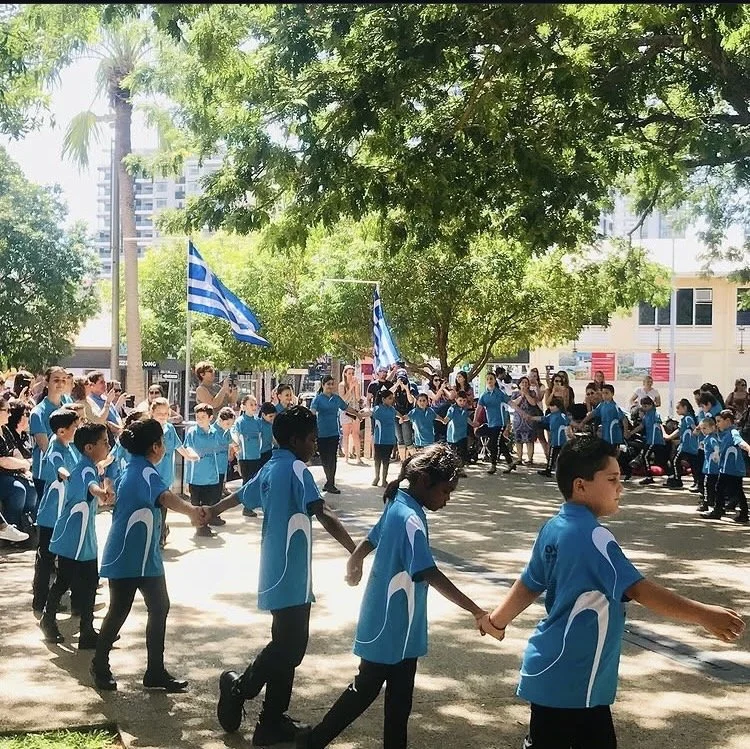
This is Darwin. We are multicultural - and proud of it.